

The tension control is not always where a casing tear starts. The weak spot may show itself before the casing has even left the opened hank. At other times the strand comes onto one side of the funnel, or the casing stops briefly under a roller that is still turning. A reduction in speed may carry the next length through, but it does not remove the edge or rubbing point that marked the previous one.
Keep the broken casing until its surface has been checked. Look first at the few centimeters before the break. An opening split has no machine rub ahead of it; a guide or funnel rub usually leaves a dull strip on the wet surface. The moment matters as well. When a strand parts as the drive takes up slack, it has met a different load and possibly a different edge from one that parts in an established feed.
Put the failed length back against the route it travelled. Its first visible damage and the machine position reached at that moment make a shorter, more useful search area.
Place the torn length next to a sound length from the same lot. A split without a rubbed lead-in can begin while the casing is opened. A smooth wet surface that becomes matte just ahead of the opening has been sliding against a contact. Measure that position from the front, and mark the corresponding point on another short casing before it is loaded. Stop the feed as that reference reaches the route, then see whether the torn area corresponds to a guide, roller, support, or funnel rim.
Startup and restart need their own observation. Slack is taken up at startup, whereas a casing in steady travel has already settled onto its route. After a stop, it may settle on another part of a guide or arrive at the roller with less even tension.
Observed pattern | Look here first | Next practical check |
Split is visible before loading | Casing condition and preparation | Open another piece from the same lot without running it |
Mark returns beside one machine position | Guide, edge, residue, or alignment | Isolate the machine and inspect that part of the route |
Scuffing appears just before the tear | Repeated slip or concentrated contact | Run one permitted contact change with the remaining setup unchanged |
Failures occur mainly at restart | Slack take-up and change in motion | Watch a planned restart separately from steady travel |
One caliber tears while the others pass | Parts fitted for that caliber | Refit its specified funnel, guide, and roller arrangement before the next short run |
Each row links a visible pattern to one part of the process. Damage present before loading sends the check back to the hank. A new scuff returning at the same guide or rim keeps the check at that machine position.
Rinse and hydrate the salted hank by the instructions from the casing supplier. Do not carry the same time and water conditions automatically to a different species or packing format. At loading, the layers should come apart without sharp tugs. The working length should remain wet, and any twist should be opened before it reaches the funnel.
Dryer areas between the folds make the layers hold together. Pull rises in the operator's hand, then drops abruptly when the stuck fold opens. In a hank wetted unevenly, the same length can alternate between easy opening and this sudden release. A casing that feels much softer than the rest should be kept as found and checked against the supplier's preparation window. Re-soaking it first would erase the difference being investigated.
Cut two short working lengths from the lot and prepare both by the supplier's stated method. Open both in the same way and watch them until they reach the first shared contact. Weak areas appearing at different places before the machine point toward the lot or its preparation. If neither piece shows damage until both pass the same guide or funnel edge, that contact becomes the immediate check.
This small comparison is not a lot-release test. It separates damage that begins during opening from a new mark that begins at one recurring contact in the feed path.
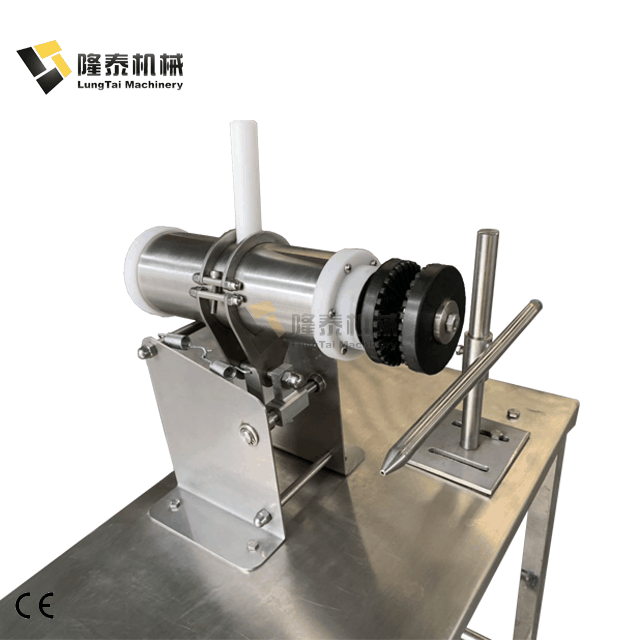
Follow the wet strand with your eyes from the pickup point, through the guides and rollers, around the funnel entrance, and on toward filling. Hands should go into that route only after the equipment has been safely isolated under the plant's procedure.
A burr can cut the casing, but a sharp metal defect is only one possibility. Dried product can harden into a ridge. A guide assembled in reverse can put its less-finished corner directly into the casing route. Cleaning wear may be confined to a patch no wider than the casing itself. A guide with a loose fastener may also move under pull, so its position at rest does not show the position it takes while feeding.
Look closely at the casing's last turn before it goes over the funnel. From above, its centerline should meet the center of the funnel entrance. A support displaced to either side keeps the wet strand bearing on that side of the funnel rim, smooth though the rim may be. The rub then develops along the corresponding side of the casing.
Food-contact parts should retain the profile and finish specified by the equipment maker; use only a documented repair method. Bending shifts the route taken by the casing, while polishing alters the condition of a surface that must also be cleaned. The pretreatment equipment range provides wider process context. On the actual installation, the relevant details are which funnels are compatible, how the casing passes each guide, which controls operators may use, and how the contact surfaces are exposed during cleaning.
Lowering tension is not a complete test instruction because two opposite contacts can tear casing. Under light roller contact, the face rotates while the casing lags and rubs. Under heavy contact, the casing moves but carries a thin pressed line. Side pull from a misaligned funnel, variable wetness, and changes in hand guidance can strengthen either pattern. The manufacturer's setup range remains the limit for any running test.
Match the funnel to the casing caliber in the work instruction and prepare a short length as usual. Run it at a conservative permitted condition. Where the manual specifies increments for roller contact, set the second prepared length one allowed increment away from the first. Its funnel, hydration time, and presentation to the roller remain unchanged.
Place both completed lengths on the same work surface and view the casing skin from the same angle. Several short rubbed areas in sequence are consistent with slip; a single narrow pressure line is consistent with firm roller contact. Light roller contact may let the wet casing slide, leaving repeated rubbing marks. Heavy contact can press a narrow band into it. If slowing the machine makes the marks disappear, repeat observation is still needed: both slip and over-contact can respond to a speed change.
Mark the break on the cycle as well as on the casing. “Just after the restart” or “while the machine was accelerating” is more useful than including it in the total for a steady run. The same event can then be watched again without changing several other conditions. Manual and powered methods are discussed in the equipment-selection comparison. For the damaged piece, concentrate on the installed funnel and caliber, the contact it had just passed, whether motion was changing, and the rub or pressure line left behind.
The supplier needs the casings that give the buyer real production work, including the regular ends of the caliber range. A demonstration with only an easy reference strand shows movement, but not whether the proposed setup suits the buyer's harder formats.
The trial request begins with the casing species, normal sizes, package form, preparation method, and funnel measurements. It also describes the working pace, mounting and power available at the line, cleaning method, and the tear or scuff that production will reject.
Where one machine will handle the whole production range, include a commonly bought small size, the main size, and the proposed upper size. Include a routine stop and restart. Before the first length is loaded, settle how much casing will be used at each condition and exactly what result will stop or fail that run. A tear limit must fit the plant's product and quality plan, as well as the casing lot and length under test; it cannot be treated as a standard value for all spoolers.
Once a run ends, put the undamaged casing apart from the section carrying the first rub or split, and measure the usable portion. Note any hands-on correction and the steps needed to exchange the funnel or casing size. The result can then be tied to the parts and setup actually used.
The purchase description should repeat the accepted arrangement. Name the operator setting used in the passing run, the replaceable wear items and accessories supplied, the access needed for inspection and cleaning, and the mounting and electrical details. The receiving check can then compare the delivered parts with the trial setup rather than relying on their general appearance.
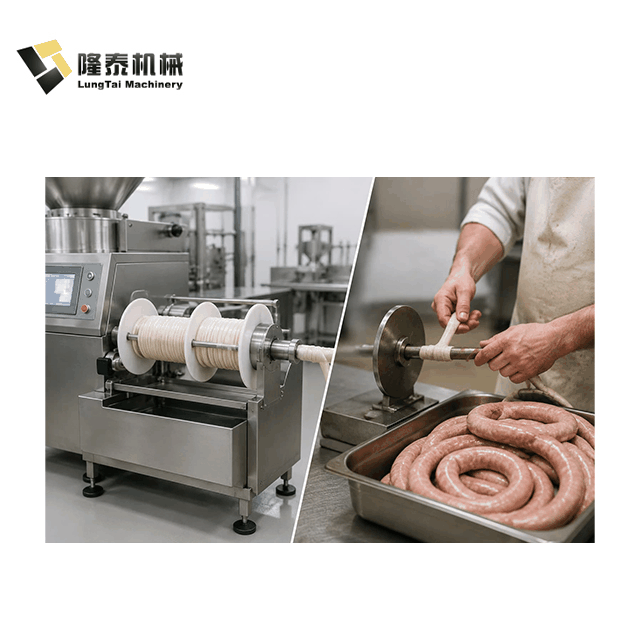
Food-processing machinery for pretreatment, processing, and post-processing is offered by LungTai Machinery (Jiaxing) Co., Ltd. The semi-automatic Natural Casing Spooler LTC-01 is designed to prepare natural hog and sheep casings before sausage filling. The product page gives a casing range of 12-50 mm and a speed of 380 rpm, and says the roller is selected for the funnel diameter.
That published range describes the spooler itself, whereas fit on the buyer's line also comes from the funnel, casing, and surrounding installation. Mounting room, utilities, cleaning access, and the casing conditions planned for a trial can be included in an enquiry through the technical contact page.
The casing surface immediately ahead of a tear often shows which part of the process came first. A weak opening split with no rub redirects attention to the hank and its preparation. A dull line that reappears at one guide, roller, or funnel rim follows that contact instead. If the break happens on restart, the key moment is when slack disappears and the wet strand seats against the feed path again.
Once the likely area is known, compare a properly prepared piece and alter only one permitted condition. Purchasing can follow the same sequence: test the casing sizes the plant uses, include a stop and restart, and carry the fitted parts and accepted settings into the quotation.
Yes. Layers that are not yet hydrated to the supplier's condition can stick and require a stronger pull to separate. Feel for that uneven drag before the casing enters any guide, and compare it with another length from the lot prepared exactly as specified.
The casing is probably meeting the same condition there on each pass. After safely isolating the equipment, inspect that position for hardened residue, a damaged edge, a loose or reversed guide, and sideways approach to the funnel.
Lowering speed may be one test allowed by the machine documentation, but first preserve the failed piece. Find the first rub or pressed band and identify whether it formed at startup, after restart, during a speed change, or once travel was steady.
Give the species, size range, package form, and preparation method supplied for the casing. Include funnel measurements, intended pace, mounting space, power, cleaning access, and the tear or surface mark that the plant regards as a failure.
Use casing from the same lots and prepare it by the same method. Run matching calibers and the same stop-restart sequence. Compare the sound length produced, surface damage, hands-on corrections, and work needed for each changeover under the pass/fail conditions chosen in advance.
Do you need more
information?
You are welcome to contact us for further information about our company or products by filling in the form below.
Email: sales@lungtai.com
