

An industrial sausage line works best when each machine is placed according to the condition of the product it receives and the next operation it must support. Tying normally sits close to filling and portioning, while peeling and cutting are post-processing steps after thermal treatment and cooling. The exact route depends on casing type, final product format, and whether the casing is retained or removed. For a technical buyer, the useful question is not simply what machine comes next, but what condition the sausage must be in before that machine can run consistently. Mapping those interfaces early reduces unnecessary handling and bottlenecks.
Tying belongs to the forming stage, so it should be evaluated together with the filler rather than as a separate downstream machine.
Product leaves the filler at a defined rate and must reach the tying point in a stable condition. If filling output and tying cycles are poorly matched, portioning and product handling can become inconsistent. The layout also needs enough access for thread handling, cleaning, adjustment, and maintenance. LungTai’s own integration guidance likewise treats filler-to-tying synchronization as a key interface rather than two unrelated operations.
Buyers planning this part of the line can review sausage tying and filling equipment when defining the equipment group around filling and portioning.
What follows tying depends on the product. Some sausages continue to cooking or smoking as linked products, while other formats use different forming methods. Before fixing the layout, the buyer should confirm casing type, portion format, filler interface, and the downstream thermal process.
Peeling belongs after the casing has completed its temporary processing role. For cellulose-cased sausages sold without the casing, thermal processing and cooling come before casing removal. The product page for the relevant peeling equipment is specifically positioned around cellulose-casing applications.
A peeler should receive sausages within a repeatable process window. Product firmness, surface moisture, diameter, and preparation method can influence casing separation, so the space between thermal processing and peeling is not just conveyor length. Cooling and holding conditions are part of the peeling process from an engineering perspective.
If cooking or cooling releases product in batches while the peeler runs continuously, the line may also need suitable accumulation or buffering. Buyers should define how long products may wait, whether their condition changes during that time, and how consistently they enter the peeler.
The automatic sausage peeler and slicer equipment category can help project teams map the transition from cooling into post-processing.
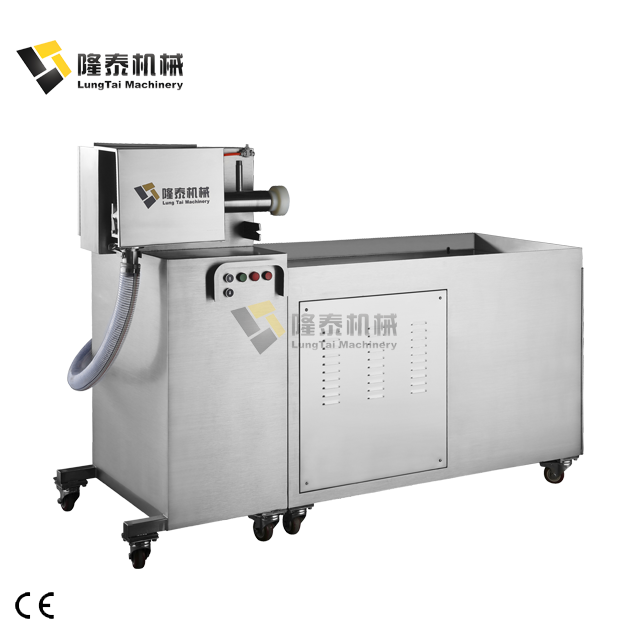
For linked sausages that retain their casing and need separation before packing, cutting is generally a downstream operation after the product has cooled and set. The cutter becomes the interface between linked product handling and packaging, which is also how the existing cutter buyer guide describes its normal line position.
The upstream conveyor should present links without excessive stretching, bunching, or irregular spacing. Downstream packaging must accept separated sausages without creating a backlog. A cutter can perform correctly by itself and still reduce line efficiency if the packaging section cannot keep pace.
During layout review, compare working height, transfer direction, conveyor speed, buffer space, cleaning access, and maintenance clearance. These details often decide whether the cutter integrates cleanly or requires extra manual handling.
Product format is equally important. A casing-retained sausage may use cutting as its main post-cooling separation step, while a cellulose-cased product intended for peeling follows a different route. Buyers should not assume cutter and peeler always appear in a fixed sequence.

The finished product specification should determine the branch. Cutter and peeler solve different problems, and many factories use them for different product families rather than as consecutive machines.
Ask three questions: Is the casing temporary or part of the finished product? Must linked sausages remain connected through cooking? Does packaging require individual pieces, grouped links, or a peeled product?
Product requirement | Main process question | Likely operation |
Casing removed after processing | How will casing separation be prepared? | Peeling |
Casing retained on finished sausage | How will links be separated? | Cutting |
Product tied during forming | How will filling and portioning synchronize? | Tying |
Several formats share one plant | Where should product routes split? | Separate or flexible branches |
This is a purchasing map, not a universal line diagram. If several sausage families share one plant, forcing every product through the same post-processing route can add handling without improving output.
Once the sequence is clear, buyers should check the handoff between machines. Many integration problems appear at these interfaces rather than inside the individual equipment.
A pre-purchase layout review should confirm product direction, working heights, sustainable throughput, buffer capacity, power requirements, cleaning boundaries, drainage, and operator access. Maintenance teams should also be able to reach adjustment and service points without moving unrelated equipment.
Line speed should be treated as a system value. If filling, tying, thermal processing, peeling, cutting, and packaging have different practical capacities, the lowest sustainable stage limits the overall line. Peak machine speed alone is therefore a weak selection criterion.
For plants planning several connected operations, the wider sausage processing layout should be mapped before individual machine positions are frozen. Conveyors, accumulation points, cleaning access, and separate product branches often need as much attention as the processing equipment itself.
LungTai Machinery (Jiaxing) Co., Ltd. manufactures equipment for sausage forming and post-processing. Buyers can use the Dual-Automatic Sausage Tying Machine WZC200D, Sausage Peeler WBP01, and Sausage Cutter LJC01 pages as technical references while mapping a line. Before equipment positions are fixed, the project team should compare casing type, portion format, cooling method, target output, packaging route, utilities, cleaning space, and maintenance access. Keeping those conditions visible during supplier discussions makes it easier to decide where each operation belongs and whether separate product branches are more practical than one fixed sequence.
Cutter, peeler, and tying machines do not form a universal three-step sequence. Tying belongs around filling and forming, while peeling and cutting serve different post-processing needs after thermal treatment and cooling. The correct layout depends on casing strategy, finished product format, line balance, and packaging requirements. Before approval, buyers should map the product condition at every handoff and confirm that conveyors, buffers, utilities, sanitation access, and maintenance space support the complete line rather than only the individual machines.
No. Tying is relevant when the product specification requires tied or linked portions. Other formats may use different forming methods, so buyers should define casing, portioning method, and filler interface before adding tying equipment.
For cellulose-cased products that require casing removal, peeling is evaluated after thermal processing and cooling preparation. The actual product condition should be confirmed during trials because firmness, moisture, and handling can affect casing separation.
No. Cutter and peeler perform different functions and are not automatically sequential. Casing-retained linked sausages may require cutting, while cellulose-cased products intended to be skinless require peeling. Product specification determines the route.
Bottlenecks often appear when practical capacities, transfer speeds, or batch patterns do not match. Buyers should compare sustainable output, buffer space, conveyor behavior, packaging capacity, and restart conditions instead of relying only on maximum rated speed.
Define casing type, product diameter, portion format, thermal process, cooling method, target output, packaging format, utilities, sanitation requirements, floor space, and expected product changes before equipment positions are finalized.
Do you need more
information?
You are welcome to contact us for further information about our company or products by filling in the form below.
Email: sales@lungtai.com
