

A sausage cutter should not be evaluated as an independent machine because its performance depends heavily on what happens before and after the cutting stage. Cooling conditions affect product firmness, upstream feeding determines cutting stability, and downstream packaging capacity influences whether the cutter can maintain continuous production. For purchasing managers and production engineers, the key question is not only whether a cutter can separate sausage links, but whether it can operate smoothly within the existing production flow. This article explains the main factors buyers should review when matching a sausage cutter with cooling systems, conveyors, and packaging lines before making an equipment decision.
Cooling is often considered a separate production step, but it directly affects the condition of the sausage entering the cutter. Product firmness, surface condition, and consistency can influence cutting stability.
After cooking or processing, sausages continue to change during cooling. A product that enters the cutter with inconsistent firmness may not behave the same way as a product from a stable cooling process.
If some batches are softer while others are firmer, operators may notice differences in cutting quality, feeding behavior, or product handling. These variations can increase adjustments and make it difficult to determine whether the issue comes from the cutter or the upstream process.
Before purchasing equipment, buyers should define:
l Product temperature range after cooling
l Cooling method used in normal production
l Expected variation between batches
l Time between cooling and cutting
The goal is not to create one perfect laboratory condition. The goal is to make sure the cutter is evaluated under the same conditions it will experience after installation.
A practical supplier trial should include products that represent normal production conditions. Testing only ideal samples may show what the machine can achieve in controlled circumstances but may not reflect daily operation.
Factories reviewing their production flow can also evaluate related sausage processing equipment to understand how upstream preparation affects later cutting performance.
A cutter depends on stable product presentation. Even a correctly adjusted cutting mechanism may produce inconsistent results if the sausage chain reaches the cutting area with irregular spacing or unstable movement.
Common issues are often related to product transfer rather than the cutter itself.
For example:
l Uneven product spacing can affect cut position
l Excessive pulling force can stretch links
l Accumulation before cutting can interrupt flow
l Poor transfer alignment can create unnecessary contact
These problems become more noticeable when the cutter is connected to existing conveyors or older production equipment.
Buyers should therefore inspect the complete route from cooling discharge to cutting entry instead of evaluating only the cutter location.
The cutter, conveyors, and surrounding equipment should work at a compatible rhythm. If upstream equipment supplies product faster than the cutter can process, accumulation may occur. If downstream equipment removes products too aggressively, it may affect stability after cutting.
During supplier discussions, buyers should provide information about:
Evaluation Point | Why It Matters |
Product transfer direction | Determines machine layout compatibility |
Conveyor speed relationship | Helps maintain stable product flow |
Available installation space | Affects accessibility and maintenance |
Product accumulation areas | Identifies possible bottlenecks |
A complete layout review helps prevent situations where the cutter performs correctly but the overall line does not.
The cutting stage does not end when the sausage is separated. The product still needs to move smoothly into weighing, sorting, packing, or other downstream processes.
Packaging capacity should be considered before selecting the cutter configuration.
If the cutter produces separated links faster than the packaging section can handle, products may accumulate. This can increase manual intervention and reduce the practical output of the entire line.
The buyer should evaluate:
l Required packaged output
l Packaging machine speed
l Buffer space between processes
l Operator involvement after cutting
The important measurement is not the cutter’s maximum capability alone. It is the production rate that the complete line can maintain consistently.
A clean cut does not guarantee efficient packaging. Products may change position, overlap, or require additional alignment before entering the next process.
A supplier trial should observe the product after cutting, not only the cutting point itself.

Matching equipment to a production line requires more than checking machine dimensions. Buyers should consider operation, maintenance, sanitation, and future production changes.
The cutter should fit the available factory environment. Important points include:
l Operator access
l Cleaning space
l Maintenance clearance
l Electrical requirements
l Product transfer height
A machine that fits physically may still create operational problems if operators cannot easily access cleaning areas or maintenance points.
Factories planning broader production upgrades can review sausage cutter machine applications when comparing installation requirements and production scenarios.
Many factories produce more than one sausage type. Future product changes should be considered before installation.
Questions for suppliers include:
l Can the machine handle the expected product range?
l How difficult is adjustment between products?
l What information is needed before changing production conditions?
l How does the line respond after restarting?
These questions help buyers avoid selecting equipment based only on current production.
Supplier evaluation should focus on technical understanding as much as equipment specifications. A supplier that understands the relationship between cooling, cutting, and packaging can provide more useful guidance during planning.
Before requesting a quotation or technical recommendation, buyers should prepare:
l Sausage type and casing information
l Product diameter range
l Cooling method
l Required output
l Existing conveyor arrangement
l Packaging process
l Factory layout limitations
With this information, suppliers can evaluate whether the proposed setup matches the actual production environment.
A cutter is one part of a larger system. Problems often appear at connection points between machines rather than inside a single piece of equipment.
A useful supplier discussion should therefore cover not only cutting performance but also integration, testing conditions, maintenance requirements, and operator workflow.
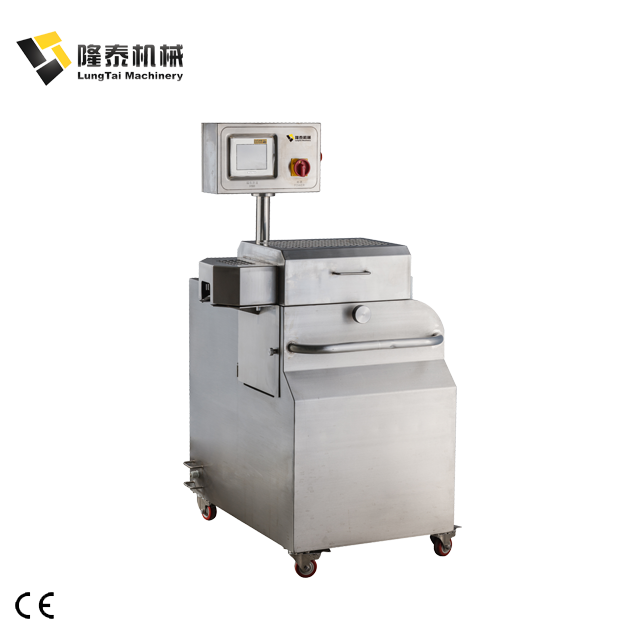
LungTai Machinery (Jiaxing) Co., Ltd. works with sausage processors to evaluate equipment requirements according to product conditions, production flow, and factory requirements. Buyers can review the Sausage Cutter LJC01 as a reference when discussing cutting applications, then provide details about cooling conditions, product dimensions, packaging requirements, and existing line layout. Through early technical communication, production teams can better understand how the cutting stage fits into the complete process and identify potential integration issues before installation.
Matching a sausage cutter with a cooling and packaging line requires evaluating the complete production process rather than the cutting machine alone. Cooling consistency, feeding stability, packaging capacity, installation conditions, and future product requirements all influence long-term performance. Buyers can reduce integration risks by testing representative products, reviewing the complete material flow, and confirming technical requirements with suppliers before final equipment approval.
Cooling affects sausage firmness and product consistency before cutting. If cooling conditions vary significantly, cutting performance may become unstable. Buyers should test products under realistic cooling conditions rather than relying only on ideal samples.
Yes. If packaging cannot handle the cutter’s output, products may accumulate after cutting. The complete line capacity should be evaluated instead of focusing only on the cutter’s maximum cutting speed.
Buyers should provide sausage type, diameter range, cooling conditions, production targets, conveyor layout, packaging requirements, available space, and sanitation expectations to support accurate equipment evaluation.
Whenever possible, yes. Testing with representative upstream and downstream conditions helps identify integration issues that may not appear during an isolated machine demonstration.
The most important factor is compatibility between the cutter and the surrounding process. Stable product flow, suitable handling conditions, and clear technical requirements are essential for reliable operation.
Do you need more
information?
You are welcome to contact us for further information about our company or products by filling in the form below.
Email: sales@lungtai.com
