

Industrial sausage link cutting systems separate a continuous chain into individual sausages at the twisted or narrowed connection points. They are not slicing machines. Blade life therefore depends less on cutting through the meat body and more on accurate product presentation, casing behavior, machine timing, alignment, sanitation, and protection from clips or foreign material. A blade may still look intact while causing missed cuts, torn casings, long tails, or irregular separation. Buyers should judge longevity by stable link separation and predictable maintenance, not by operating hours alone.
The blade normally works at the link neck rather than through the sausage body. Wear increases when the product arrives off-center, under excessive tension, or outside the timing window.
Uniform twist length lets the guide and cutting unit present each connection at a repeatable position. Short, loose, or inconsistent necks make the blade contact casing folds, product shoulders, or neighboring links instead of the intended separation point.
Excessive tension stretches the casing and pulls the link during cutting. Too little tension allows buckling or rotation. Both conditions increase side loading and may make the edge rub against guides or an opposing blade. Feed belts, rollers, and guides should move the product without flattening it or changing link pitch.
The cutter must synchronize product movement, link detection, and blade actuation. At higher speed, a small timing error becomes a larger positional error. Late actuation may strike the sausage body; early actuation may miss the neck or cut only part of the casing.
Repeated dry cycling, abrupt stops, and jams also load the blade mount and drive. Operators should investigate missed cuts or unusual noise instead of increasing blade force to hide a feeding or sensor problem.
Natural, collagen, cellulose, and plastic casings do not separate in the same way. Their thickness, toughness, elasticity, moisture, and twist retention affect the force needed for a clean cut.
A tough or elastic casing may stretch before it severs, leaving a tail or pulling the link sideways. A dry or brittle casing may crack beyond the intended cut. Double layers at a folded neck increase resistance, while inconsistent filling pressure changes neck shape.
Trials should use the actual casing supplier, diameter, filling pressure, twist count, and product temperature. A blade approved on one casing may behave differently after a material change, even when sausage size appears unchanged.
Metal clips, hooks, wire fragments, and broken machine parts can chip or bend a blade in one contact. Products closed with clips require enough distance between the clip and cutting point. Detection and guide settings should keep the cutter outside the closure zone.
Upstream inspection, metal-detection controls where appropriate, and clear jam-removal procedures reduce impact damage. A blade should never be forced through a misplaced clip or hardened obstruction.
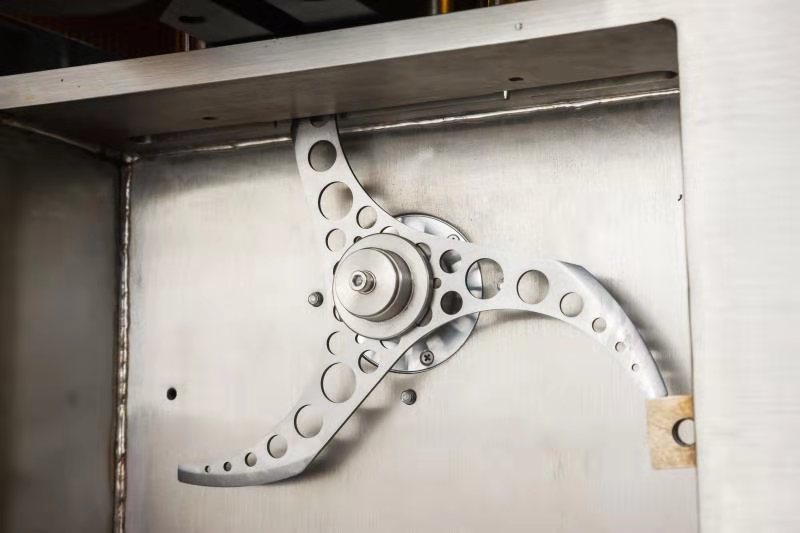
Blade material matters, but edge geometry, mounting, clearance, and cutting action determine how efficiently it works. A hard blade installed out of alignment may fail sooner than a more forgiving blade in a controlled mechanism.
Buyers should define blade material, heat treatment, hardness range, thickness, edge angle, surface finish, mounting holes, and dimensional tolerance. Corrosion resistance matters because the blade is exposed to water, protein residue, salt, and cleaning chemicals.
A very acute edge may cut casing easily but chip under impact. A thicker edge tolerates more abuse yet may stretch the casing before separation. The suitable profile depends on casing type, blade motion, neck width, and whether the machine uses a single blade, opposing blades, or supported shear.
The blade should enter the link neck without scraping guides, guards, anvils, or the opposite cutting element. Incorrect clearance causes rubbing, heat, burr formation, and uneven wear. Loose bearings, worn bushings, shaft play, and damaged holders can shift the cutting path.
After replacement, technicians should verify position, fastener torque, free movement, and the complete cycle at low speed. Changing only the blade may leave the original cause unresolved.
Food-processing sanitation protects product safety, but incorrect cleaning can reduce blade life. Residue, chemicals, and careless handling all affect the cutting edge.
Fat, protein, casing fragments, and seasoning can collect near the blade and increase drag. They should be removed before deposits harden. Cleaning chemicals must be used at the approved concentration, temperature, and contact time, followed by suitable rinsing and drying.
Chloride exposure, scratched surfaces, and trapped moisture can promote pitting. Operators should avoid steel tools that scrape the blade or pry against the edge. Inspect the holder, guards, and guides after sanitation as well.
Sharpening is appropriate only while the blade remains within dimensional, balance, and damage limits. The original edge angle and symmetry must be preserved. Uneven grinding can change the cutting path or create vibration.
Replacement criteria should include missed-cut frequency, tail length, casing tearing, visible chips, burrs, corrosion, remaining dimensions, and approved sharpening cycles. Maintenance records should identify the product, casing, line speed, sanitation method, and reason for removal.
Blade longevity should be assessed during production trials with actual linked sausage, not with empty cycling or isolated casing samples. The trial needs enough runtime to expose feeding drift and residue buildup.
Record line speed, link spacing, casing type, product temperature, cut position, missed cuts, double cuts, casing tears, tail length, deformation, blade noise, vibration, and residue buildup. Check results at startup, after warm-up, and after continuous operation.
Trials should also cover changeovers between diameters or casing types. Easy blade access, guarded maintenance positions, alignment checks, and safe cleaning are part of lifecycle performance because poor access encourages rushed servicing.
Request blade drawings, material specifications, hardness limits, mounting tolerances, sharpening guidance, inspection criteria, and spare-part lead times. Replacement blades should fit the approved holder without filing or manual adjustment.
Changes to blade material, heat treatment, edge profile, sensor, guide, feed belt, holder, shaft, or timing should require review. Retained samples and service records help distinguish normal wear from a production or component change.
LungTai Machinery (Jiaxing) Co., Ltd. supplies sausage processing machinery for industrial food production, including equipment used to separate linked sausage chains into individual portions. Buyers can provide sausage diameter, casing type, twist length, closure method, line speed, product temperature, and required cut position. Trials should check feed stability, link detection, synchronization, missed cuts, casing tears, tail length, blade alignment, vibration, sanitation access, and changeover behavior. Quotations should identify the machine configuration, blade specification, included spares, inspection items, lead time, and maintenance requirements. Before production, both parties should approve drawings, physical samples, acceptance criteria, and replacement-part references for future servicing and maintenance planning.
Blade longevity in industrial sausage link cutting systems depends mainly on accurate product presentation and controlled cutting at the connection point. Link spacing, casing behavior, feed tension, sensor timing, blade geometry, alignment, sanitation, and protection from clips all influence service life. Buyers should test the actual sausage chain under realistic operating conditions and track cut quality over time. A stable feeding and cutting system usually protects the blade more effectively than selecting a harder material alone.
No. The machine normally separates a linked sausage chain at the twisted or narrowed connection point. Correct feeding and timing keep the blade away from the filled body.
Possible causes include poor link positioning, loose chain tension, worn guides, delayed blade timing, a dull edge, unsuitable clearance, or inconsistent twist length between individual sausages.
There is no universal answer. Wear depends on casing toughness, thickness, moisture, folded layers, neck consistency, line speed, blade geometry, and whether clips or foreign material enter the cutting zone.
Check cut position, missed cuts, double cuts, casing tears, tail length, product deformation, feed stability, timing, blade vibration, residue buildup, sanitation access, and performance after continuous operation.
Maintain consistent link spacing, control chain tension, align the blade and guides, verify timing, clean correctly, prevent clip contact, sharpen to the approved profile, and replace worn mechanism parts.
Do you need more
information?
You are welcome to contact us for further information about our company or products by filling in the form below.
Email: sales@lungtai.com
