

The global processed meat industry is adopting automation at pace in response to a host of issues including ongoing labor shortages, increased hygiene controls and a drive for increased efficiency on an ongoing basis. One of the key innovations to emerge in recent times and to achieve widespread adoption in processing plants around the world is the automatic sausage peeler. The automatic sausage peeler removes the natural casing from the sausage with speed and precision and is now a staple of processing lines globally, enabling a step change in terms of increased efficiency, a number of key benefits together with compliance to relevant food safety legislation. This article looks at how the modern sausage casing peeler can increase a number of key measures and benefits and assist in processing meats more safely on an ongoing basis.
Automatic sausage peelers are becoming increasingly popular in the meat processing industry as automation continues to change the face of the food manufacturing industry. Many of the changes in the food manufacturing industry are driven by economics and that is also true for the use of automatic sausage peelers in the meat processing industry.
A persistent lack of workers affects the global meat industry. Companies are struggling to hold on to skilled workers for tasks that are dull and lack challenge such as removing casings from products. With increasing labor costs, the use of automation is becoming more attractive for medium-sized companies in the sector. According to the Food Processing Automation Report (2023), 68% of medium-sized companies from the meat processing sector plan to automate a production step within the next three years. Automatic sausage peeler systems are also useful for maintaining the quality of output. A mid-size European frankfurter producer uses an automatic peeler for its products. It has reported a 35% reduction in overtime hours among its staff since it introduced the system. Workers are now able to focus on tasks such as checking products for quality and monitoring production lines that pack products.
Meat processing requires high standards of hygiene. Manual peeling of sausages is extremely high risk due to the constant coming into contact with products by human hands. Automated sausage peelers are made from stainless steel and are supplied with sausage’s via controlled water or air flow systems. This enables the meat processor to maintain very high levels of sanitation at all times. In addition the automated peeler helps to ensure that HACCP protocols and EU food safety laws are adhered to by incorporating into the daily cleaning cycle. This helps to reduce surface area of product that is contaminated and also reduces the number of non-conformance reports during audits, which can have a severe effect on a company’s brand and also impact on exports.
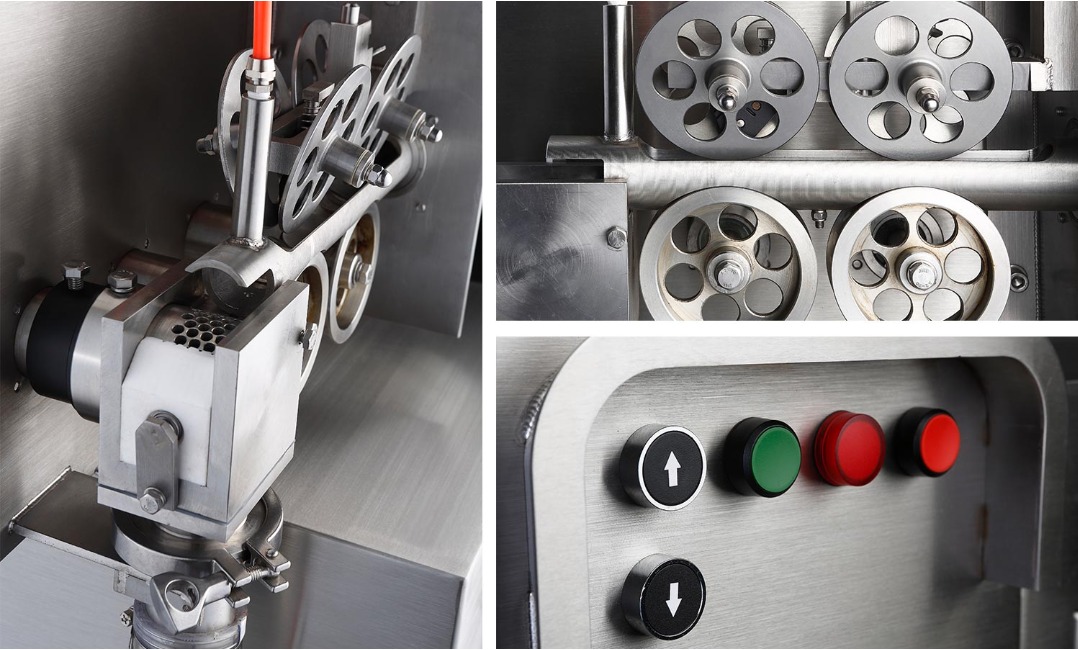
To get an idea of the value of the machines that we offer, a look at the inner mechanics and the design of the machines is necessary.
Typical high-speed sausage peelers use air or water jets to remove casings from the sausage, while doing their best not to damage the rest of the product. To achieve this, advanced sensors constantly monitor differences in the sizes and surface textures of individual sausages and, as required, continuously optimizes the peeling pressure for different types of sausage – such as hot dogs and Vienna sausages. In order to process sausages of this kind in high quantities, sausage peelers are equipped with so-called continuous feed conveyors. The advantage here is the constant processing of sausages in a high speed. For example, a North American processor was able to double its hourly production by switching from manual peeling at individual peeling stations to processing on an automated line with a dual-lane conveyor belt.
A modern sausage peeler has been engineered to provide maximum reliability combined with protection of the operator. By using a pneumatic peeling head the peeling process is free from mechanical friction and damage to product is kept to an absolute minimum of 1%. The safety interlocks on the machine instantly stop the peeling process if an irregular object is placed within the peeling area or if a sausage has not been placed within the correct position on the peeling mandrel. Access to all areas for cleaning and maintenance is via large ergonomically designed access panels. This allows for very quick cleaning of all areas between shifts, an aspect which is very important as any downtime for sanitation will affect the daily yield of product. A peeler that is designed and engineered to provide maximum performance of speed, precision and safety is difficult to match with manual processing.
Automatic removal of casings generates real benefits which can be quantified in terms of costs saved, higher yields, and better products.
Increased automation will yield higher processing throughputs and reduced labor expenses. According to a 2022 report from MeatTech Insights, a peeling system automatically can reduce a plant’s labor expenses by as much as 40% or so. Additionally, increased automation allows for greatly reduced down time between completed production runs. This in turn can allow for greatly increased daily processing throughputs at existing floor space and employing levels. Change-overs from one sausage diameter to another will also be greatly reduced allowing for maximized processing time while continuing to guarantee exact processing parameters. This is especially critical for processors that are generating many different SKUs, all being required to be delivered to their customers on exact time schedules.
The uniform peeling of the sausages through our machinery is very important, especially for retail packaging as appearance can create a perception of quality to the end consumer. Additionally, uniform peeling of the casing creates less product loss during removal which we have established creates an increase in overall yield of 2-4% on average. This additional yield will save a lot of money when translated to millions of units per year. It also removes the need for rework currently caused by items not being cut uniformly or not fully peeled in manual processing.
Scalability is usually the deciding factor for evaluating long-term automation solutions in the food manufacturing industry.
Automatic sausage peelers are generally offered as modular solutions to add more peeling lanes as demand increases. This makes for incremental upgrades rather than full changes of new machinery. Furthermore, they can also be easily integrated into existing lines of conveyors or packaging machinery. For full end-to-end automation this can also be done in a relatively short space of time without needing too much rework.
The durability of a processor is a crucial factor for the total cost of ownership. Machines made of stainless steel last more than 10 years if they are used properly. New sensors of the predictive maintenance enable the operators to replace wear components even before they fail. This prevents unplanned stoppages, which are disturbing for the production. The return on investment for most processors is achieved within 18 to 24 months, since the sum of the savings by means of labor and material is high.
Before buying an automatic system those deciding to buy should check a number of factors related to the goals of their operation.
Production Volume Requirements
Processors should try to match the machines' capacity with their current output while leaving some room for expansion with the help of future demand trends.
Compatibility With Product Range
Adaptability matters: ensure that the chosen equipment accommodates various sausage diameters, lengths, and casing types—whether natural or collagen-based—to avoid bottlenecks when switching recipes or brands.
Cleaning and Maintenance Simplicity
The ease with which an apparatus can be cleaned for sanitation purposes directly affects its Uptime Efficiency. Designing an apparatus with easy-to-remove parts, such as quick-release parts, or with tool-free disassembly facilitates an efficient sanitizing process, for example up to 30% faster. In a multi-shift operation, such where each shift is 8 hours long, this represents a substantial amount of time within which to complete cleaning, and thus keep the apparatus operating at maximum efficiency between shifts.
Supplier Support and Spare Parts Availability
We continue to provide reliable after-sales service to our customers throughout peak periods. Our regional hubs mean that our customers have access to spare parts inventory close to where they are needed, enabling us to maintain rapid repair times and avoid delays associated with procurement from overseas.
LungTai Machinery (Jiaxing) Co., Ltd., located in Zhejiang Province, China, is recognized as a specialist manufacturer of automated meat processing machinery including advanced sausage peeler machines used globally by mid-to-large-scale producers. The company provides more than just equipment—it offers technical consulting on line integration strategies, operator training programs tailored to client workflows, spare parts logistics management, and remote troubleshooting assistance through digital channels. Its focus lies in building sustainable partnerships grounded in reliability, regulatory compliance support, and continuous performance optimization rather than short-term sales transactions.
Automatic sausage peelers are state-of-the-art products which are used in many modern meat processing plants worldwide. As peelers automatically peel sausages from their casings, they increase productivity and ensure highest level of hygiene. The most important advantage of automatic sausage peelers is their modular design. Therefore, they are ideal for companies of all sizes and allow users to grow step by step without having to invest too much money too early. In addition to the long durability of automatic sausage peelers, also the fast ROI is very attractive for forward-thinking meat processors, who are looking for a solution to work efficiently, also in times of shortage of skilled labor. Only close co-operation between suppliers of food processing technology and the companies which are processing the food will lead to the necessary development of development of new hygienic solutions for production of safe food by means of precision made automation. LungTai Machinery (Jiaxing) Co., Ltd., a leading supplier of meat processing machinery, is one of the companies which are perfectly able to meet the challenges of the future.
Automatic peelers can be used for processing of frankfurters, hot dogs, Vienna sausages and other similar emulsified meats using natural or collagen casings.
Routine cleaning after each shift is recommended; full preventive maintenance is usually scheduled quarterly depending on usage intensity.
Yes, Most modern machines can be easily integrated into existing production lines by connecting to conveyors, cutters or packaging lines using standard industrial communication.
Interlocks, stop buttons, open face shields and pressure release valves to automatically release should any accidental overpressure occur.
The expected payback time frame for processors is between 1.5 to 2 years. This is largely due to labor cost savings and increased product yield across all production shifts.
Do you need more
information?
You are welcome to contact us for further information about our company or products by filling in the form below.
Email: sales@lungtai.com
