

Sausage production is a delicate balance of art and engineering, where every step—from mixing and stuffing to linking and cutting—affects the final product’s quality. Precise portioning is especially critical because it determines not only the uniformity of each sausage link but also the efficiency of downstream packaging processes. In recent years, automation has transformed this stage of production. Modern meat processors increasingly rely on specialized machines such as the automatic sausage link cutter to achieve consistent results at high speed. These systems eliminate manual inconsistencies, reduce waste, and maintain hygiene standards required by regulatory bodies. According to data from the Food Processing Machinery Association, automation adoption in meat processing has grown by approximately 12% annually, reflecting the industry’s rapid shift toward precision-driven manufacturing.
To first understand the working principle of sausage link cutter, it is important to first understand what the tool does and how it can play important role in industrial production.
Sausage cutter, precision made sausage cutting machine that cuts linked sausages of same length. We can cut them to the exact size required and keep the casings intact. Used on production lines that produce thousands of sausage per hour these machines are able to keep up the pace. Many styles of casing are available for use in these machines, natural, collagen and cellulose. There are sausage cutting machines to suit every type of sausage from breakfast sausage to gourmet smoked sausage.
Sausage link cutters combine the mechanical accuracy of cutting units with the control provided by digital control systems to give optimum performance.
Conveyor System
The conveyor belt transports the connected sausages through the cutting area at constant speed. Due to the constant distance between the single links they are cut with exact precision.
Cutting Mechanism
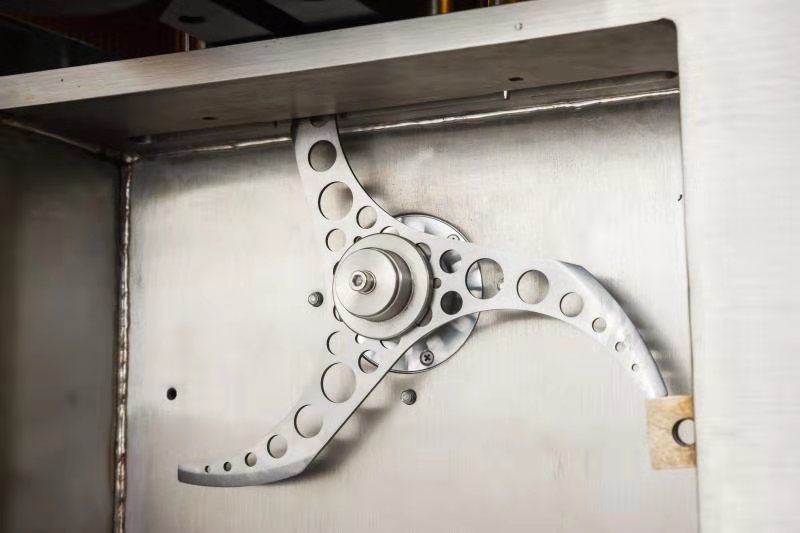
At the heart of our sausage cutting system are the cutting components. These can be very fastly rotating knives or so-called guillotines. The cutting components cut the sausages in a clean way, without damaging the casing. This creates a good look and guarantees the quality of the product.
Control Interface
The intuitive control panel for easy operation of the machine allows to preselect link length, belt speed and cutting frequency. As a result, easy changeover from one article to another or from one recipe to another is possible and reduces standstill times during production changeovers.
An automatic sausage link cutter is one of the machines found in modern days meat processing plants. The following is how the machine operates.
We begin by inserting linked sausages into the machine by means of a chute or conveyor belt. Sensors embedded in the machine are able to measure the space between individual links, or alternatively be pre-programmed with a set length. When the cutting mechanism is activated, the individual sausages are cleanly cut from their linked companions. The newly cut links are then ready to be packaged or sent on to other parts of the processing plant.
Automation increases the accuracy and the repeatability of the processes. The most advanced cutting models are equipped with servo-motors that control the blades with precision while synchronizing them with the conveyor belt. A PLC (Programmable Logic Controller) controls and processes all the information of the system, managing the parameters that are related to the feed rate, safety and other components. The real-time feedback allows the operator to monitor and to control parameters such as the blade wear, and the product flow rate, in order to produce the same quality of output in every batch, with the minimum amount of waste possible.
Automating cut sausage production will deliver more benefits than just reducing manpower.
According to a 2023 report by the International Meat Processing Association, facilities using automated cutters have reduced manual labor costs by up to 60%. Continuous operation capability means fewer interruptions for operator fatigue or human error, translating into higher daily throughput rates.
Maintaining uniform product length is critical for how products are stacked on the sales floor as well as customer perceptions. Our automated cutters precisely cut products to exact lengths within millimeters of tolerance and keep casing from breaking – a common problem with manual cutters which can result in wasted product and rework.
While the initial investment for automation can appear costly at first, the long-term cost savings of not having to deal with waste and constant maintenance will rapidly pay for the system. Typically within 12-18 months of full operation, the processor will have achieved full return on investment based off of their volume of production. This makes modernization a very sound financial decision.
There are several operational variables that affect how a sausage link cutter will perform on the production line.
Natural casings are more sensitive and elastic, prone to tear when under too much pressure. Synthetic casings made from collagen or cellulose are easier to cut at higher speeds because they are of even thickness and have definite strength characteristics.
Regular calibration of the blade to ensure it is cut at the correct point as detected by the sensors, along with regular sharpening to extend the life of the blade and prevent fraying of the cut edges which can affect the product’s appearance and shelf life. Scheduled inspections to detect wear of components before they cause a failure resulting in costly downtime.
Although processes are largely automated, human beings are still needed. Above all, they must be trained. During switching from one sausage diameter or from one recipe to another, for example, the necessary adjustments can be made by hand. In the operation as well as in the maintenance of sausage filling machines safety guards and stop buttons are installed to protect humans from injury by contact with moving parts. Modern machines are designed accordingly.
Selecting the right equipment to use depends on matching the key characteristics of the chosen piece of equipment with your specific needs.
Tabletop units of moderate capacity are the best for small, individual producers while industrial cutters have thousands of cuts per hour and must be precise.
Designing work flows efficiently requires integration capability. Machines must be compatible with existing stuffers, conveyors and packaging lines in order to avoid bottlenecks when integrating them into the production process.
After-sales service that is reliable is important for the long-term production capacity. Local service by technicians for spare parts as well as for maintenance work prevents unnecessary standstill time for replacement of parts. Often this is not taken into account, however, it is especially important for companies with a high production volume.
LungTai Machinery (Jiaxing) Co., Ltd. in Zhejiang province of China, for decades specializing in food processing machines, serves the global meat industries. LungTai Machinery (Jiaxing) Co., Ltd. Automatic Sausage Cutters are custom-designed for different types of casings and in various diameters to be adapted to processing-line speeds of commercial food plants worldwide. The company is fully committed to providing customers not only quality products but also professional after sales services, i.e. demonstrate and explain how to operate machines at the time of installation; conduct operators’ training sessions; supply quality spare parts in time; troubleshooting on customers’ behalf by phone or via internet. LungTai Machinery (Jiaxing) Co., Ltd.’s diligent efforts are made to guarantee long lasting and efficient performances of its processing equipments installed in clients’ factories all over the globe.
Automated sausage link cutters are one of the key products used in modern meat processing plants. With precision engineering and digital control, these machines are able to deliver consistent results in high volume production environments whilst at the same time eliminating the need for manual labor, a major cost in traditional cutting rooms. Also, by cutting accurately through the casings without damage, they increase both the yield and the visual appeal of the sausages for retail sale. Importantly, with careful selection on capacity and integration into the existing plant, Automated Sausage Link Cutters can deliver rapid payback through increased efficiency and reduced waste.
Automatic cutters are capable of cutting fresh, cooked or smoked sausages with natural or synthetic casings of any diameter within the confines of an industrial food manufacturing plant.
The frequency of maintenance of the blades depends heavily on the frequency of use, typically every 4–6 weeks in industrial 24/7 type operation.
Yes. Most modern filling machine models are equipped with modular interfaces that can be very easily connected to existing stuffing machines or to existing lines on a conveyor system. This also allows for easy integration into work processes without expensive conversion work.
Do you need more
information?
You are welcome to contact us for further information about our company or products by filling in the form below.
Email: sales@lungtai.com
